
Key Principles and Requirements of ISO 41001
A practical framework for resilient, efficient, and sustainable facility management
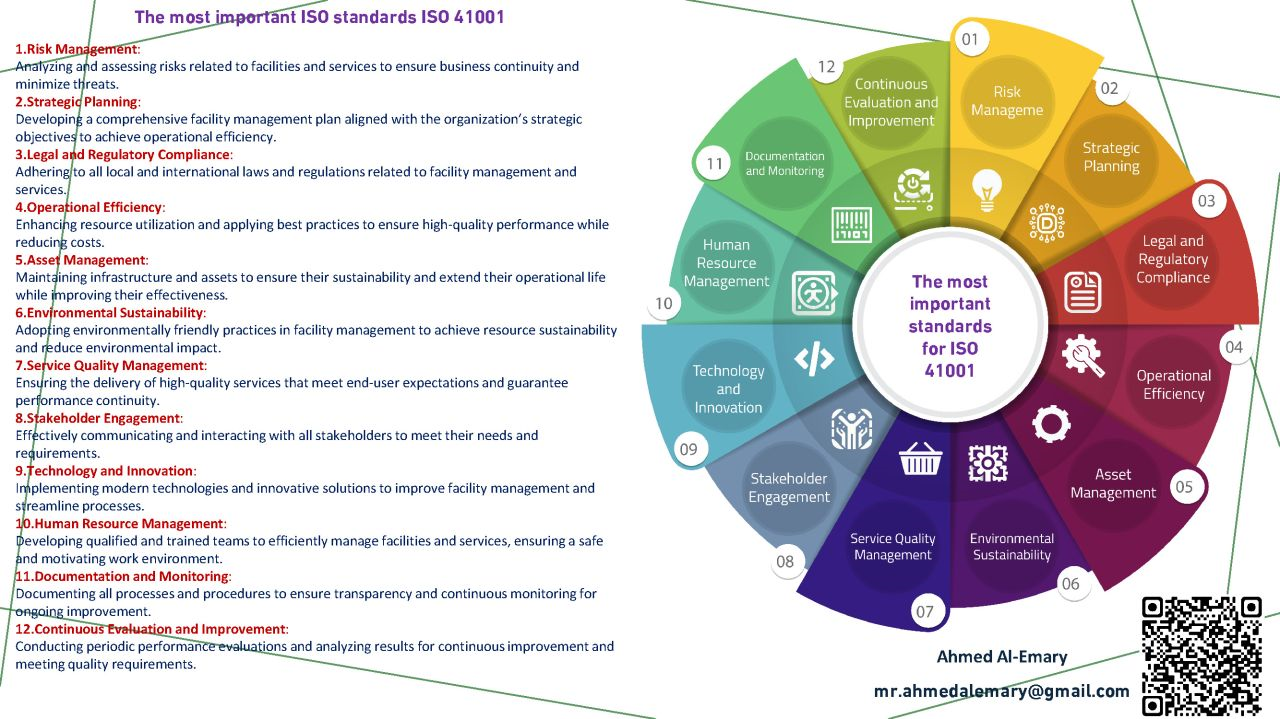
Facility Management (FM) is a critical function that directly influences an organization's operational efficiency, business continuity, workplace environment, and overall performance. It is no longer limited to building maintenance or the delivery of day-to-day support services. Instead, it has evolved into a strategic discipline that integrates people, places, processes, infrastructure, and services to support organizational objectives and maximize the value of available resources.
In this context, ISO 41001 - Facility Management Management Systems provides an internationally recognized framework that helps organizations establish, implement, maintain, and continually improve an effective Facility Management System. Its purpose is to ensure that facility management services are aligned with organizational needs and the requirements of relevant interested parties.
Successful implementation depends on several interconnected management and operational principles. The following twelve areas highlight some of the most important practices that contribute to an effective Facility Management System.
1. Risk Management
Risk management is essential to maintaining the reliability and continuity of facility management services while minimizing potential disruptions and losses.
It involves identifying risks associated with buildings, infrastructure, equipment, operations, and service delivery; assessing their likelihood and potential impact; and establishing appropriate preventive, mitigation, and emergency response measures.
Effective risk management goes beyond responding to failures after they occur. It requires a proactive approach that identifies potential threats early and reduces their impact on organizational operations.
2. Strategic Planning
Facility Management should be integrated into the organization's overall strategic planning rather than treated as an isolated operational function.
This requires developing a Facility Management strategy that aligns with organizational objectives, current operational requirements, and future business needs.
Key activities include defining strategic and operational objectives, establishing service-level expectations, identifying required resources, planning investments and improvements, and developing performance indicators to measure the contribution of Facility Management to organizational success.
3. Legal and Regulatory Compliance
An effective Facility Management System must identify and comply with all relevant legal, regulatory, contractual, and other applicable obligations.
These may include requirements related to building safety, occupational health and safety, fire protection, environmental management, waste disposal, permits, licenses, and regulatory authorities, as well as contractual commitments.
Compliance should not be limited to identifying applicable requirements. Organizations must also assign responsibilities, establish monitoring mechanisms, verify compliance, and address any identified nonconformities.
4. Operational Efficiency
Operational efficiency focuses on achieving the best possible results through the effective use of available resources while maintaining the required quality and performance of services.
This can be achieved by optimizing operational processes, improving work methods, reducing waste and unnecessary costs, strengthening maintenance planning, increasing workforce productivity, and using performance data to identify improvement opportunities.
A successful Facility Management function must maintain an appropriate balance between service cost, quality, reliability, and the value delivered to end users.
5. Asset Management
Facilities, infrastructure, and equipment represent significant organizational investments. Their management therefore requires a structured approach throughout the entire asset lifecycle.
This includes asset handover and commissioning, operation, maintenance, upgrading, and eventual replacement or disposal when necessary.
Effective asset management involves maintaining accurate asset registers, assessing asset condition and criticality, developing preventive and corrective maintenance plans, monitoring failures and maintenance costs, and evaluating remaining useful life.
The objective is to maintain asset reliability, extend operational life, and maximize the value generated from organizational investments.
6. Environmental Sustainability
Environmental sustainability has become an important consideration in modern Facility Management due to its impact on operating costs, environmental responsibility, and the quality of the built environment.
Relevant practices include reducing energy and water consumption, minimizing waste, improving the efficiency of lighting and HVAC systems, using resources responsibly, and adopting solutions that reduce the environmental impact of operations and services.
Sustainability should not be treated as a collection of isolated initiatives. It should be integrated into strategic planning, daily operations, asset management, and procurement decisions.
7. Service Quality Management
The effectiveness of Facility Management depends on its ability to deliver services that meet the needs and expectations of the organization and its end users.
This requires defining service scopes and quality standards, establishing Service Level Agreements (SLAs), monitoring Key Performance Indicators (KPIs), measuring user satisfaction, addressing complaints and feedback, and evaluating service providers against agreed performance requirements.
The objective is to move beyond simply completing activities and focus on measuring service outcomes, consistency, and the actual value delivered to users.
8. Stakeholder Engagement
Effective Facility Management requires a clear understanding of the needs and expectations of all relevant interested parties.
These may include senior management, operational departments, employees, end users, service providers, suppliers, and regulatory authorities.
Engagement can be strengthened through effective communication channels, coordination meetings, satisfaction surveys, feedback mechanisms, and periodic reviews of stakeholder requirements.
This approach helps reduce expectation gaps, improve service delivery, and strengthen collaboration between Facility Management and other organizational functions.
9. Technology and Innovation
Technology plays an increasingly important role in improving Facility Management performance by providing accurate information, supporting better decisions, and reducing dependence on manual processes.
Common digital solutions include Computerized Maintenance Management Systems (CMMS), Computer-Aided Facility Management (CAFM) systems, Internet of Things (IoT) technologies, Building Management Systems (BMS), digital analytics, and predictive maintenance solutions.
These technologies support asset monitoring, maintenance scheduling, service request management, failure analysis, resource consumption monitoring, and faster operational response.
10. Human Resource Management
The success of Facility Management depends significantly on the competence and capability of the people responsible for delivering its services.
Organizations should establish clear roles, responsibilities, and authorities; provide appropriately qualified personnel; assess training needs; implement competency development programs; evaluate employee performance; and promote a culture of safety, quality, and teamwork.
It is also essential to ensure that employees and service providers possess the necessary competence to perform their assigned tasks and understand the relevant operational requirements and procedures.
11. Documentation and Monitoring
Documented information provides an essential foundation for ensuring process consistency, operational traceability, and verification of compliance.
It may include policies and procedures, asset registers, maintenance plans, inspection records, breakdown reports, service requests, performance reports, training records, nonconformity reports, and corrective action records.
The value of documentation goes beyond record retention. It provides objective evidence for decision-making, supports audits and management reviews, and helps preserve organizational knowledge.
12. Performance Evaluation and Continual Improvement
A Facility Management System is not complete simply because policies and procedures have been established or a certification has been obtained. Its effectiveness must be regularly evaluated to ensure that it achieves the intended results.
This involves monitoring performance indicators, measuring the achievement of objectives, conducting internal audits, carrying out management reviews, analyzing complaints and nonconformities, identifying root causes, and implementing corrective and improvement actions.
Evaluation results should provide a basis for updating plans, improving processes, and continuously enhancing service performance.
How Does ISO 41001 Improve Facility Management?
Implementing a Facility Management System in line with ISO 41001 helps organizations move from a reactive approach focused on resolving daily operational issues toward a more integrated and proactive management model.
This model is based on strategic planning, governance, performance measurement, risk management, and continual improvement.
It also helps clarify responsibilities, strengthen coordination between departments, improve service quality, optimize the use of assets and resources, and enhance the organization's ability to meet stakeholder needs and maintain business continuity.
Conclusion
Successful Facility Management is much more than maintaining buildings or operating support services. It is an integrated management discipline that brings together strategic planning, asset and risk management, operational efficiency, service quality, human resources, technology, compliance, and continual improvement.
ISO 41001 provides a management framework that helps organizations bring these elements together within a structured system, creating measurable business value, supporting sustainability, and strengthening organizational excellence.